Submissions for the next newsletter
can be submitted to admin@tasa.org.au.
| Dear ~~first_name~~,
Our TASA 2026 Conference Program is now available! We are looking forward to bringing everyone together on Kabi Kabi Country on the Sunshine Coast in November for Revolution and Resistance.
There is plenty more to share in this week’s newsletter. We highlight two employment opportunities in Health Sociology at the University of Tasmania and extend our warm congratulations to five TASA members who have recently been awarded Future Fellowships. We are particularly pleased to note that three of the five are Associate Editors of Health Sociology Review.
We also welcome two new members to TASA and share a write-up and photos from Water & Words, a TASA-funded Social Sciences Week event. Alongside these updates, we have new publications from TASA members and two new calls for participants in research projects.
We hope you enjoy this week’s updates.
| We extend our warm congratulations to the following members who have been awarded a future fellowship:
- Sophie Lewis: On Borrowed Time: A Sociological Study of Life Expectancies. This project aims to investigate the possibilities and complexities of living with incurable conditions over an extended time from multiple perspectives (people with incurable conditions, families, care providers). Using a longitudinal qualitative design and a strengths-based approach, this research will generate new knowledge about how Australians navigate the challenges of living for years with incurable illness and what enables them to live well. This project will produce a suite of publicly available resources and inform policy to support people with incurable conditions, their families and care providers. This should provide benefits such as better, more inclusive supports for people navigating long-term incurable illness.
- Adrian Farrugia: Reconceptualising harm reduction for young people. This project aims to develop an innovative approach that will reduce the harm related to young Australians’ drug use. It is expected to generate urgently needed new knowledge on the relationship between the priorities that currently guide harm reduction responses and young people’s own concerns about and experiences of drug harms. Through a collaborative process involving novel theory, sophisticated methods and consultation with experts, service providers and young people, the project intends to produce new responses that engage directly with young people’s perspectives, making them more relevant and effective. Anticipated benefits include reduced drug-related harm among young Australians and a lower overall drug-related burden of disease.
- Brendan Churchill: Making it Count: Closing the Data-Action Gap for Global Gender Equality. Across the world, governments rely on data to advance workplace gender equality, yet progress remains uneven. Counting inequality has not been enough to drive change. This project will transform how gender equality is measured and realised by showing how reporting systems can move from mechanisms of compliance to catalysts for reform. Through comparative research across Australia, France and the United Kingdom, it will generate a transformative framework for gender-data governance globally. Expected outcomes include best-practice guidelines for inclusive data collection, new theoretical insights into how data systems shape equality, and a Global Gender Data Summit uniting experts to drive lasting, systemic and inclusive reform worldwide.
- Zoe Staines: Click for care—quality, safety, & equity in digital care platforms. This project aims to investigate how gig-economy digital care platforms—apps connecting care workers with aged, disability, and childcare recipients—are transforming how care is experienced and valued. Using innovative digital methods, interviews, and co-design, the project expects to generate new knowledge about how platforms impact care quality, safety, and equity for workers, recipients, and informal (family) carers. Expected outcomes include world-first evidence guiding new policies and strategies to address regulatory gaps and challenge structural care devaluation. This should provide significant benefits, including to strengthen protections, enhance care quality and safety, and improve the sustainability of Australia's care sector.
- Julia Coffey: Automating faces: Visual AI facial technologies and their impacts for youth. This Fellowship will investigate how the rapid rise of visual AI technologies in everyday life is impacting young people. Through world-first qualitative research, the project will generate new knowledge of the social and cultural implications of visual AI technologies that recognise and change faces. Using a cutting-edge youth-centred methodology and theories of visual digital culture, technologies and embodiment, this Fellowship will enhance Australia’s international research capacity to understand how visual AI technologies are changing how humans navigate identity. The Fellowship will provide significant benefits through informing new responses to support young people's safety, privacy, and wellbeing.
| TASA Key Dates at a glance
|
- 12 October - Sociology of Youth 'Engaging with Young People' symposium
- 15 October - Sociology of Sports & Leisure TASA Thursdays
- 15 October - Social Theory TASA Thursdays
- 16 October - Housing & Urban Sociology symposium 'Ready or Not?: Improving adoptability of regional, rural & remote preparedness research'
- 20 October - A Sociology of Emotions & Affect Symposium
- 22 October - Families & Relationships 'Transition to Parenthood' event
- 22 October - TASA Thursdays - Beyond Data: Stories, Power, & Lived Experience in Sociological Research
- 23 October - Sociology of Religion symposium 'Leaving Religion and the Politics of Nonreligion'
- 26 October - Sociology of Youth 'Catch up and Write' session
- 29 October - TASA Thursdays - A Robot for Every Home: On The Robotisation of the Domestic Sphere
- 6 November - TASA Executive Meeting
- 18 November - Remote, Regional & Rural symposium
- 23 November - Migration, Ethnicity and Multiculturalism symposium 'Theorising migration, settlement and diversity in unsettled times'
- 23 November - TASA Executive Meeting
- 23 -27 November - TASA 2026
| On Sunday the 20th September, ten strangers came together for the first time to participate in a swimming and writing workshop at Wangaratta Sports and Aquatic Centre. Funded through TASA’s Social Sciences Week funding, the Wangaratta Masters Swimming Club event, titled “Water and Words”, involved participating in a swimming activity and collective writing session.
The swimming segment involved an adapted swimming program to suit swimmers’ abilities and goals. It included a creative method for participants to capture their thoughts during the swim by writing on a laminated sheet of paper with special graphite pencil, without fear of these being erased by the pool water. After drying off, swimmers made their way to the “writing room” where they took part in a 25 minute “shut up and write” session, facilitated by TASA member and Wangaratta Masters swimmer, Alexa Ridgway. During this time, they used their notes from the swim to create their own written works. Read on...
| A warm welcome to new members Joy Uchendu and Ario M Ariani. We hope you are enjoying this issue. You can stay connected with the latest events, publications and opportunities in sociology through TASA’s weekly E-Newsletter.
We also extend our thanks to all our renewing members. We encourage everyone, particularly our postgraduate members, to add a backup email address to their member profile. This helps ensure you stay connected with TASA when you move institutions or workplaces, and means you can continue to access your membership, the E-Newsletter and other TASA resources wherever your career takes you.
| This below section provides a snapshot of recent publications shared with us by TASA members. We know our members are producing an enormous range of valuable sociological research, books, articles and other publications, and we’d love to help showcase more of this work.
If you have a recent publication you’d like us to share with TASA's community, and beyond, please send us the details. We’d love to hear about your work and include it in a future newsletter. | |
Book Chapters
Journals
Tarafder, T.; Sultan, P.; Khan, S.I.; Ahmed, A.S.I.; Salam, A. RFID-Enabled Traceability, Anti-Counterfeiting and Sustainability in Apparel and Product-Based Supply Chains: A Scoping Review. Sustainability 2026, 18, 9334. https://doi.org/10.3390/su18189334 [open access].
Hamada, I., & Cho, H. E. (2026). Migration, gender and legal consciousness: navigating post-separation among East Asian women in Australia. Journal of Ethnic and Migration Studies, 1–23. https://doi.org/10.1080/1369183X.2026.2732718 [open access].
Op-ed / Commentary
| Journal of Sociology, 62 (3)
Issue 62:3 includes a Special Issue on 'Towards a pedagogy of care in higher-ed institutions', guest edited by Siddhi Bhandari and Riddhi Bhandari. A sociologist and anthropologist respectively, the Bhandari sisters have brought together scholars from India and beyond to shape a new concept, 'pedagogy of care', which offers a critical lens on how higher education institutions instrumentalise the work of care. All articles are available here.
Teaching Notes - call for peer reviewers
The JoS editorial team are calling for people willing to peer review submissions for the new Teaching Notes section in Journal of Sociology. Teaching Notes offers a space for dialogue among sociology teachers to share research and reflections on teaching practices. Teaching notes have been set up to be more accessible to teaching-focused staff who often have limited time for research with shorter, 4,000-word length for articles. Finding peer reviewers for Teaching Notes can be more challenging as online academic profiles are geared toward research interests and often hide the significant expertise and interests that scholars hold in pedagogy, curricula, and teaching.
If you would be willing to review a future Teaching Note, please send your details to the Teaching Note Editors garrity.hill@unimelb.edu.au and nicholas.pendergrast@unimelb.edu.au. Please include your name, email, and 3 topics of interest. Your details will be kept in a secure database to consult for future peer review requests. Of course you can still always decline to review when the request comes if you are too busy at that time.
| | TASA Thursdays 15 October 12:30pm
How does research move beyond publication to create meaningful change? Join Ramón Spaaij, Mary Woessner, Ruth Jeanes and Simone Fullagar for this complimentary online seminar exploring the realities of research impact. Through practical examples from sport, gender equity, violence prevention and policy, the session will examine knowledge translation, stakeholder engagement and pathways to influence. Gain practical strategies for planning, demonstrating and sustaining research impact across grants, promotion, policy, practice, community engagement and opportunities.
CLICK HERE TO REGISTER
| | | | TASA Thursdays 15 October 12:30pm
Join us for the 4th installment of TASA's Social Theory Thematic Group Webinar Series, "Paradoxes of Hope and Ideology," which will be presented by Craig Browne.
Craig will expand on the social diagnosis of the self-contradictory tendencies of contemporary capitalist modernity outlined in his recent book The Dialectic of Control: Sketch for a Critical Theory of Society (2026). He argues that many of these contradictions are manifest in the changing complexions of hope and ideology.
| | | | TASA THURSDAYS PG | Beyond Data: Stories, Power and Lived Experience in Sociological Research
Join us for TASA Thursdays Postgrad on 22 October as Dr Nashid Nigar explores what it means to move beyond data in sociological research. This session examines how stories, lived experience, power and relationships can challenge fixed categories and measurable outputs, opening space for richer reflexive inquiry. Ideal for postgraduate researchers and others interested in qualitative, critical and community-engaged approaches, this complimentary webinar invites you to rethink how sociology captures complexity in everyday social life.
| | | | TASA THURSDAYS | A Robot for Every Home’: On The Robotisation of the Domestic Sphere
Join us for TASA Thursdays on 29 October as sociologist Jessie Liu, winner of the 2025 Jean Martin Award, explores the growing robotisation of the home. From robotic carers and servants to companions, home robots are increasingly being promoted as part of our domestic future. Drawing on ethnographic research, Jessie will look beyond the industry hype to examine the realities of home robotics and the politics of technology, labour and design. Register for this complimentary webinar to explore whose future these technologies are really creating.
| | | 2026 Monthly ‘Catch Up & Write’ Sessions
Hosted by the Sociology of Youth Thematic Group
Register to receive Zoom links + save the dates in your calendar!
ONLINE 1:00PM TO 3:30PM AEST
MONDAY 26 OCTOBER | REGISTER HERE*
This is the final catch up for 2026.
The Sociology of Youth team look forward to seeing you at an upcoming session!
If possible, please give the new TASA Sociology of Youth LinkedIn page a follow and share amongst your networks.
| How is climate change reshaping health and wellbeing in rural, regional and remote Australia? Join the Remote, Regional & Rural Sociology Thematic Group for Climate Change, Systems Disruptions, and Human Health in Rural Communities Symposium at La Trobe University’s Albury/Wodonga Campus on Friday 16 October 2026.
Share your research, hear new perspectives and connect with others working across climate, health and rural communities.
REGISTER HERE
| | | Care and Hope in the Time of Permacrisis: A Sociology of Emotions & Affect Symposium will be held on Tuesday 20 October 2026, 1.00–5.30 pm at RMIT City Campus.
The symposium will explore care, hope, grief, anxiety, precarity and the emotional practices that sustain social life in difficult times.
Abstract submissions close TOMORROW 2 October. Scholars, practitioners, HDR candidates and ECRs are warmly invited to submit an abstract or register to attend.
Click here to register
Submit an Abstract
| | | | Transitions to Parenthood
Monash University and online
Friday, 23 October, 9:30 am – 5:30 pm
| | | | Engaging with Young People: Constructing, Conducting, and Translating Meaningful Research
Monday, 12 October 2026 from 9:30 AM to 4:00 PM (AEDT)
University of Sydney + Online
Free event (limited tickets available)
This workshop, co-hosted by the Sydney Centre for Healthy Societies and TASA's Sociology of Youth Thematic Group, will be a semi-structured space for researchers (HDR, early career, and established), industry practitioners, and young people to engage in critical conversations about the promise and complexities of youth-focused research. The workshop will also examine how youth research can be practiced in ethical and considered ways, and explore how to navigate its emotive and caring dimensions.
| | | Ready or Not?: Improving adoptability of regional, rural & remote preparedness research | 16 October 2026 | 9:30am - 1:30pm
Join the Remote, Regional & Rural Sociology thematic group, along with academics, professionals, students and community members for Ready or Not?: Improving adoptability of regional, rural & remote preparedness research, a half-day hybrid event exploring how research can better support regional, rural and remote Australia through challenging and disruptive futures. Hear from leading voices, take part in thoughtful discussions and build valuable connections across sectors. Attend online for free or In person
REGISTER HERE
| | | Leaving Religion and the Politics of Nonreligion
This symposium, hosted by the Sociology of Religion thematic group & held alongside the 50th anniversary of Religious Studies at the University of Sydney, invites researchers to explore nonreligion as a subject in its own right. Papers are invited on themes including deconversion, religious trauma and recovery, ex-member communities, post-religious life, the politics of nonreligion, the “Mark No Religion” campaign, and the complexities of measuring nonreligion.
University of Sydney, Friday 23 October, hybrid.
| | | | Theorising migration, settlement and diversity in unsettled times
Symposium Keynote: fellow member Amanda Wise
TASA’s Migration, Ethnicity and Multiculturalism and Social Theory Thematic Groups invite submissions for a half-day symposium exploring the theoretical foundations, current developments and future directions of migration, ethnicity and multiculturalism research.
23 November, University of the Sunshine Coast.
| | | | Sociology from and for the Regions, 18 November 9:30am - 2pm.
Join fellow members Merete Schmidt, Peta Cook and Nicholas Hookway exploring what regional communities can teach us about inequality, resilience, connection and social change, while considering how local knowledge and community voices can play a stronger role in shaping research, policy and practice.
Australia’s regional communities continue to navigate complex social and economic challenges, including unequal access to education, healthcare and housing, limited employment opportunities, changing industries and population shifts. While these issues are often addressed through broad policy responses, the lived experiences of regional communities can be overlooked.
REGISTER HERE | | | Health Sociology Review, Volume 35, Number 2 (July, 2026).
All articles in the latest issue are available here.
| New: Lecturer/Senior Lecturer in Health Sociology (Indigenous)
University of Tasmania
As the Lecturer or Senior Lecturer in Health Sociology, you will deliver high-quality teaching across undergraduate and postgraduate programs, with a particular focus on embedding Aboriginal and Torres Strait Islander knowledges and perspectives. Working collaboratively, you will contribute to teaching, research and partnerships that strengthen culturally responsive approaches to health and address health inequalities and inequities.
New: Lecturer in Health Sociology
University of Tasmania
As a Lecturer in Health Sociology you will work within a collaborative, multi-disciplinary team to deliver programs and teach students attending University of Tasmania campuses located in Launceston, Hobart, Burnie, and Sydney. This position is a teaching-intensive academic role with a particular focus on embedding cultural safety into the learning content within our contributions to the University’s nursing and allied health curriculum. The position will require success in teaching, research and service, with a research allocation designed to contribute to the School’s record of research excellence and impact in health sociology.
| Early Career Scholarship Opportunities
| 2027-2029 Global Scholars Program
Early Career Researchers (1st 5 years)
Canadian Institute for Advanced Research
The three opportunities related to sociology are:
There are no citizenship or geographic restrictions on who may apply. For full eligibility details read on...
| PhD Scholarship Opportunities
| Understanding the Role of Sport in Reducing Loneliness and Fostering Social Connection in Contemporary Australia
School of Humanities and Social Sciences, University of Tasmania
This PhD project will examine the changing relationship between sport, social connection, and loneliness in contemporary Australia. Against the background of declining participation in competitive club sport and the rise of informal sports, this project investigates the role sport may play in reducing loneliness for at-risk groups such as young people, midlife men, people from marginalised backgrounds, those living in regional and rural areas, or people living with disability.
Working with fellow member Nicholas Hookway.
Legal needs, access to justice and intersecting inequalities
Institute for Culture and Society, Western Sydney University with Law and Justice Foundation of NSW
This PhD project aims to contribute theoretical and applied knowledge to better understand inequalities in people’s experiences of legal problems and the opportunities for meaningful reforms that address intersectional disadvantages. There is flexibility as to the precise focus of the PhD thesis. The proposed project should align with the aims of the two partners, but can focus on a particular affected population, type of legal issue, experience of legal need, specific context, aspect of the legal assistance sector’s work or other relevant topic of interest. Tax-free stipend of $45,188 per year.
Working with fellow member Catherine Hastings (incoming TASA Secretary) and Dr Kate Davies (L&J Foundation)
Application deadline: 31 October. Read on...
Border Security: Managing a Shared Responsibility Approach to Biosecurity at the Frontline
School of Humanities and Social Sciences, University of Tasmania
This PhD project will investigate how those working in border biosecurity – at ports and airports – interpret their roles, responsibilities, and everyday practices. This includes investigating how border biosecurity personnel understand their role as part of a shared responsibility approach, the ways in which they work with and collaborate with others, the forms of expertise, skill, and judgement used in making decisions, the challenges they face as part of their role, and how they navigate, work with or work around these to reach outcomes that are judged to be legitimate and credible.
Working with fellow member Vaughan Higgins.
Application deadline: TODAY 1 October. Read on....
| Other Events, News & Opportunities
|
Fernanda Beigel, sociologist and researcher based in Argentina, is looking for partners interested in collaborating in international projects to be presented to the Council on Australia Latin America Relations (COALAR) Grants or other funding opportunities in Australia aimed to foster interactions between Australia and Latin America. Fernanda is the Director of the Research center on the Circulation of Knowledge: https://cecic.fcp.uncuyo.edu.ar/en/
| New: AI literacy and implementation across tertiary HLSS (Humanities, Languages, and Social Sciences) disciplines.
With the guidance/supervision of their tutor, fellow member Dr Clarissa Carden, the group is focusing on effective AI integration in tertiary education with a focus on a shared understanding between educators and students regarding acceptable AI use.
As part of their project, they are calling on TASA members to respond to the following questions:
1. Do you feel current tertiary AI boundaries and literacy standards align with what employers and research fields expect of graduates?
2. In what ways do broad, university-wide AI policies succeed or fail when applied to the specific needs of Sociological disciplines?
3. From your organisation’s perspective, how widespread is the confusion surrounding AI use across Australian higher education?
4. How can educators maintain core Sociological academic standards while navigating increasing student AI usage?
5. What key guidance or principles should be included in a discipline-specific AI framework for Sociology educators?
The Informed Consent Form is available here.
The full project call is available here.
| | New: Development of a training intervention
Griffith University researchers are working to strengthen how disability support workers are prepared to work with people with intellectual and/or neurodevelopmental disabilities who exhibit complex and challenging behaviours. They are seeking participants with experience supporting this cohort of people with disabilities as:
- Service and training providers for support workers
- Disability support workers
- Family members, carers, and advocates
Participants will take part in a one-hour interview to discuss their experiences, with their insights contributing to the development of a training intervention for future disability support workers.
| | | Project invitation - Wellbeing of Baby boomer women living with disability in retirement/ semi-retirement
Were you born between 1946 to 1964, live in Tasmania or Victoria, and identify as a woman living with disability, chronic pain, or a mental health condition acquired before retirement? If so, we would like to hear your experiences in a confidential interview. To find out more and get involved, contact Peta.Cook@utas.edu.au for an information package. This study has been approved by the University of Tasmania Human Research Ethics Committee (HREC) Number H40747.
| | | Call for Fellowship Nominations
Academy of the Social Sciences in Australia
The Academy Fellowship currently comprises around 750 Fellows, of whom 38% are women, and 15 identify as Aboriginal or Torres Strait Islander.
Fellows of the Academy include Australia’s leading researchers and practitioners across the breadth of social science disciplines, as well as a number of honorary Fellows (those who have made significant contributions to the social sciences beyond research), and overseas Fellows working outside of Australia.
To become a Fellow of the Academy individuals must be nominated by three existing Fellows (a proposer and two seconders), and have demonstrated an outstanding contribution to one or more fields of social science research or practice in Australia. Nominations are considered by the Academy’s disciplinary Panels, by independent assessors, then by the Membership Committee before being put to a vote of Academy Fellows in a general ballot.
| People Places Prize
Future Leaders
Prize $10,000
The People Places Prize 2026 is about creative and innovative ideas for living places. The Prize is open to Australian citizens and residents aged 18 and over. The winner will receive $10,000 and their ideas featured on www.peopleplaces.org.au.
Creative and innovative ideas for the Prize can be in any (or combination) of four areas.
– The Arts
– Green spaces
– Building design
– Disability access
Entry deadline: 1 November. Read on...
|  | Award for Excellence in Research
The ISA Award for Excellence in Research and Practice is granted by the International Sociological Association to a sociologist whose outstanding contributions advance and promote sociological knowledge and practice, while strengthening the discipline, the profession, and the ISA.
Worldwide Competition for Junior Sociologists
The Competition is open to eligible junior sociologists who obtained their first Master’s degree (or an equivalent graduate diploma) in sociology or in a closely related discipline less than 10 years prior to 30 October 2026. In cases of joint or multiple authorship, this rule applies to all authors of the submitted paper.
| Summits
Australian Social Cohesion
5-6 November, Melbourne
The summit will explore the forces shaping Australia’s social fabric through the theme: Understanding Australia’s Social Fabric: Diversity, Connections, and the Future of Social Cohesion.
Seminars
Digital Well-Being: A Dream or a Crisis?
Monday 26 October at 5.30pm at ACMI (Melb) or online
The event will explore the idea of digital wellbeing, including how it is being defined, debated, and mobilised across research, policy and practice.
ANU School of Sociology Seminar Series
The program for the ANU School of Sociology Seminar Series is now online. All seminars are hybrid, with options to join via Zoom. Please visit the School’s Humanitix page, here, to view and register for upcoming seminars.
Newcastle Youth Studies Centre (NYSC) 2026 Online Seminar Series
The full 2026 program for the Newcastle Youth Studies Centre’s online seminar series is now out (see below), you can check out each seminar, and register for them, at the NYSC Eventbrite page here.
Note, you can watch the full 2025 recordings at the NYSC's YouTube playlist here.
|  | Conferences
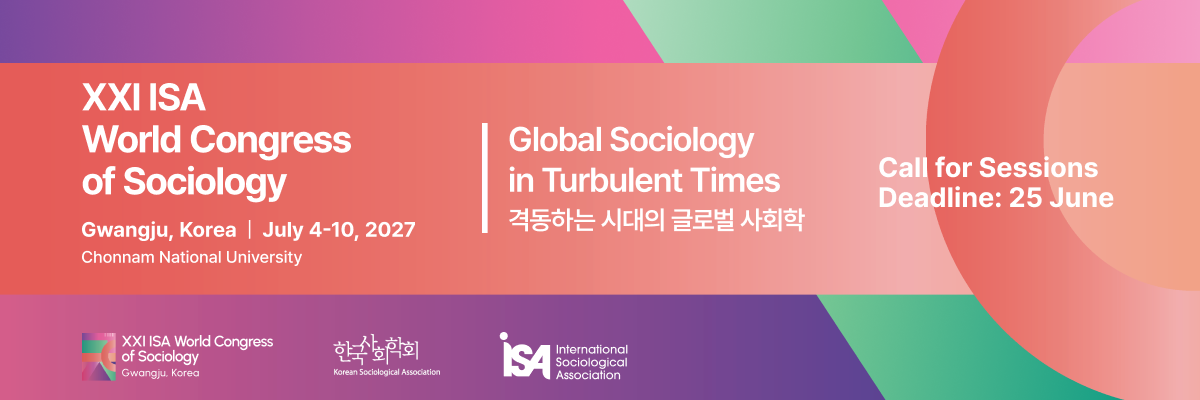
Global Sociology in Turbulent Times
International Sociological Association
XXI ISA World Congress of Sociology
4 to 10 July 2027, Gwangju, Korea
Abstract submission deadline: 14 October. Read on...
Ageing Multiple: Navigating Relational and Social Lives of Ageing, Caring and Dying
ISA World Congress of Sociology 2027
This session—listed under both RC11 Sociology of Aging and RC15 Sociology of Health —sits at the intersection of ageing, caring, and dying. We invite cutting-edge cross-disciplinary scholarship to couple ageing with processes of caring, dying, and endings to consider it to be fundamentally social, relational, and multiple.
Towards a post-sustainability society? New challenges, agendas, and roles in socio-ecological transformation and its research
16-18 March 2027, TU Dortmund University, Germany
Abstract submission deadline: 15 November. Read on....
Trust and Resilience: Shaping the Future of Global Cooperation
International Social Capital Association
The world is living through one of the most volatile stretches in a generation — active wars, fracturing alliances, and a global order under real strain. Social Capital 2027 brings together the world’s leading researchers, policymakers, and practitioners for three days to confront a question that is no longer theoretical: how do societies build the trust and resilience needed to keep cooperating across borders, sectors, and divides — when the ties that once seemed permanent can no longer be assumed?
| Call for Submissions - Special Issues
Epistemic Emotions in and around the law
Frontiers in Sociology of Law
Editors: Renata Grossi, Eve Hanan, Alessandra Minissale, Cecilia Nordquist, Kate Rossmanith.
Law and Emotion scholars have consistently challenged the reason versus emotion divide in our understandings of law and legal processes, scholars have established that emotion in law is methodologically sound, and epistemically significant. More recently an additional tool has emerged to further such investigations: epistemic emotions.
Abstract submission deadline: 5 November. Read on....
Rethinking Gender Pressures, Education and Wellbeing in Schools
Guest Editors: Associate Professor Garth Stahl (The University of Queensland), Dr. Sarah McDonald (Adelaide University), Dr. Rohann Irving (Flinders University), Professor Murray Drummond (Flinders University)
Gender is a fundamental dimension of child and adolescent development, and growing research highlights the influence of gender norms, expectations, and stereotypes on student wellbeing. Across school, family, peer, and digital contexts, young people encounter gendered pressures that shape their bculine and feminine ideals, gender based harassment, and internalised gender role stress are associated with elevated rates of anxiety, depression, self-harm, eating disorders, and suicidal ideation.
Manuscript submission deadline: 31 January, 2027. Read on...
Health security and health and care workforce resilience conflicts, crises and capacities
Health Policy, Elsevier, published in collaboration with the European Observatory on Health Systems and Policies
Guest editors: Ellen Kuhlmann, Katarzyna Dubas-Jakóbczyk, Michelle Falkenbach, Gabriela Lotta
Health security depends on a resilient health and care workforce. Yet climate change, pandemics, hybrid and armed conflicts, migration and rapidly evolving digital technologies are converging with a severe health and care workforce crisis, exposing major gaps in current health security policies. This special issue explores how health and care workforce resilience can become a cornerstone of health security through stronger governance, leadership, implementation and transsectoral policies. We welcome contributions covering all areas of the health and care workforce addressing health security challenges in single or multiple countries, primarily high-income countries in line with the journal’s scope.
Submission deadline: 31 January 2027 (acceptance to online publication: two days). Read on...
| For membership information, processes, and frequently used resources, visit the Members' Navigator. To contact a member of the team directly, see our TASA Staff page.
| Admin (Sally): admin@tasa.org.au
Events (Penny): events@tasa.org.au
Membership (Ali): membership@tasa.org.au
Indigenous (Morgan): indigenoussociology@tasa.org.au
Digital Publications Editor (Roger): digitalpe@tasa.org.au
Thematic Groups (Habib): thematicgroups@tasa.org.au
Postgraduates (Brooklyn): postgraduates@tasa.org.au | |