Non-religion, Spirituality & Secularism in Public Symposium
Geraldine Smith and Rhys Gower with Rosie Clare Shorter, Katja Strehle, Misha Hoo, Mercedes Nachón Ramírez, Neville Buch & Sivaan Walker.
Introduction
On the 3rd October 2025, the Sociology of Religion Thematic Group hosted scholars from the field of studies in religion and sociology of religion to the University of Sydney to discuss the emergence of non-religion in western societies. For this event, we partnered with the Australian Association for the Study of Religion’s (AASR) Women’s Caucus, who on the previous day ran an afternoon session on women working in non-religion and spirituality. AASR Women’s Caucus Leader Dr Tara Smith and the TASA Sociology of Religion TG convenors collaborated on having a shared theme on non-religion, scheduling our events consecutively, utilising each other’s social media and communication channels, and shared academic networks to encourage attendance to both our events. This was an excellent partnership because as studies in religion is a small field many of the same people are part of both associations and want to maintain collegial relationships between the two associations. As Misha Hoo notes in the reflections below, it was a ‘friendly and collegial’ event which fostered connections between emerging and established scholars. In practical terms, for people who were travelling interstate they were glad to be able to attend both events.
This report begins by acknowledging the passing of Professor Marian Maddox. We then outline the significant interest the symposium received, explain our rationale for hosting the event, situate the organisers, speakers and attendees, and detail the symposium proceedings. The final section of this report includes a series of reflections composed by some of the people who took part in the event.
Professor Marian Maddox
In the lead-up to this event, we received the sad news that Professor Marian Maddox had passed away. Marian Maddox was a renowned scholar of religion and a beloved mentor to many Australian scholars. Her funeral was scheduled on the same day as the symposium and there were many in attendance who were leaving later in the day to attend the funeral. Therefore, we begin this report with an acknowledgement of her passing and prolific contribution to the study of religion.
International Interest
We would like to note that there was a significant amount of international interest for this event and wanted to suggest that TASA may be interested in a more explicit engagement with providing international scholarships for TG events. At least two students from India attempted to make it to Australia and one person from Argentina travelled to Sydney to attend the event. We also had several scholars travel internationally for the event.
Rationale
Over the past 50 years, Australia, like many other Western nations, has witnessed a significant rise in people claiming no religious affiliation (Pew Research Center, 2015). With religious ‘nones’ having represented only 6.7 percent of the Australian population in 1971, this percentage later increased to
12.9 percent in 1991, 23.1 percent in 2011, and 38.9 percent as of the most recent census in 2021 (Australian Bureau of Statistics, 2022). ‘No Religion’ now stands as the second most common religious affiliation in Australia next to Christianity (43.9%).
It is through noting this significant rise that sociologists of religion have become increasingly engaged with the non-religious sphere both in Australia and worldwide. Scholars have been investigating reasons for non-religious affiliation – analysing the circumstances under which Australia is becoming increasingly non-religious (Halafoff & Gobey, 2018; Halafoff et al, 2020; Hughes, 2017; Possamai, Kamp & Gower, 2024). At the same time, Australian sociologists of religion have also been exploring the inherent diversity of the non-religious sphere (Halafoff, Singleton & Poulos, 2024; Gower, 2021; Nixon, 2014; Singleton, 2015). With scholars recognising that individuals can have different relationships with the spiritual while still remaining non-religious, the term ‘No Religion’ can thus be understood as indicative of numerous different identity positions (everything from ‘spiritual but not religious’ to active atheist) (Possamai & Tittensor, 2022).
Organisers
The Sociology of Religion TG is unique because we have four convenors. Rosie Shorter, Rhys Gower, Zoe Alderton and Geraldine Smith have held this position since November 2022. In one of the sociology of religion sessions at the 2022 TASA conference we all simultaneously put up our hands in response to the TG convenor at the time, Dr Enqi Weng asking who would like to be a convenor. None of us are that competitive, and no one wanted to exclude another, so we decided we all could be co-convenors and received permission from TASA to have four convenors. For this event we also worked closely with Dr Katja Strehle. Katja originally suggested the idea for a symposium on non-religion. Katja’s PhD thesis, which she recently completed, was on gender and non-religion. She wanted to connect with others in what is a small and disparate field. Katja therefore became the main organiser for the event and took on this role with great diligence.
Contributors and Attendees
We had 25 attendees on the day. Eight of those attending were our presenters who were either based in Sydney or had travelled from Brisbane, Newcastle, Melbourne, and even Buenos Aires. We also had several Undergraduate and Honours Students from the University of Sydney’s Studies in Religion department, and several HDR candidates. We also had in attendance Dr Steven Sutcliffe from the University of Edinburgh, who is well known internationally for his work on holistic spirituality and the new age. The symposium took place at the University of Sydney, and the venue was kindly provided by Dr Christopher Hartney, Chair of the Studies in Religion, who booked the room for us at no cost.
We were very fortunate that we were able to invite several major scholars in this field to support the event by participating in a roundtable and running workshops. Associate Professor Anna Halafoff from Deakin University kindly agreed to run a workshop on methodologies to study non-religion and spirituality. We also had a roundtable which included Professor Andrew Singleton from Deakin University, who has written on a wide range of topics that intersect into this field. Notably, he has published extensively on religion, non-religion, and spirituality amongst Gen Z; Dr Rosemary Hancock from Notre Dame University who has recently been researching the role of community gardens; Professor Paul Bramadat from the University of Victoria in Canada who recently published a book on yoga; and Dr Christopher Hartney, who has written on the sacrality of the ANZAC myth and religious diversity.
Summary of the Event
Introductions
The day began with an introduction by Dr Christopher Hartney who thanked TASA for allowing such an event to take place at the University of Sydney. He thanked Katja Strehle for her work in facilitating the event alongside the TASA TG convenors. He also said a few moving words on the passing of Marian Maddox. This was followed by an Acknowledgement of Country delivered by Rosie Shorter.
ECR/HDR Roundtable
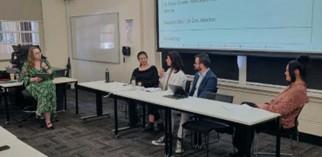
Our first item on the program was an ECR/HDR roundtable with Dr Rhys Gower, Mercedes Nachon Ramirez, Misha Hoo, and Dr Katja Strehle, chaired by Dr Zoe Alderton. Notably, Mercedes and Misha are still completing their PhDs on topics related to non-religion, while Katja has recently graduated. We are thrilled to have provided this platform for emerging scholars to share their work as we see this support as a key part of our role as convenors.
Workshop: Researching Non-religion: Tools, Methods, and Challenges
Next, Assoc Prof. Anna Halafoff ran a workshop on methodologies for researching non-religion and spirituality. She gave us the choice to join three thematic groups based on our research experience. The groups were ‘Spiritual-but-not-Religious,’ ‘Nature Religion/Spirituality’ and ‘Atheism and Secularism.’ Once convened in our groups she had us elect a scribe and go around in our groups identifying theories and concepts we used in our research for that topic.
Anna had us share our discussion with the rest of the attendees. She then asked us to share methodologies and challenges when researching our chosen area. The discussions in each group were loud and full, and the workshop went overtime as there was much to share and discuss within and between each group.
Roundtable: Secularism, Spirituality, and the Public Sphere: Whose Voice Counts? Is religion re-entering the public space in Australia?
After morning tea, we had our next roundtable with Dr Rosemary Hancock, Prof Andrew Singleton, Prof Paul Bramadat, and Dr Christopher Hartney. Katja, who was chairing the session, led the discussion by noting that in the recent assembling of the NSW Faith Advisory Board – which is an interfaith council of representatives of each major religious tradition set up by the NSW government – there were no atheist or humanist organisations invited to the table. This provoked a discussion about the role of atheist and humanist organisations within public institutions, whether they belonged there to represent the 39% of Australians identifying as a religious ‘none,’ and whether the inclusion of atheist/humanist organisations was warranted as the organisations themselves may not be representative of non-religious people.
Presentations Session 1
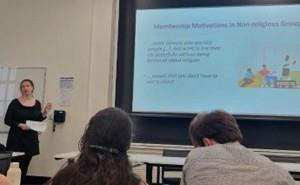

After lunch, we began our two sessions of presenters. Dr Katja Strehle, an ECR affiliated with Western Sydney University and the University of Sydney, began with a presentation called ‘Beyond Herding Cats: The Varied Group Lives of Nonreligious Women.’ In this presentation, she skilfully dispelled the myth that atheists are ‘non-joiners’ by showing the survey data she collected that those part of atheist or humanist organisations are also part of an array of other community organisations, including religious ones.
Dr Sharon Smith, an ECR affiliated with the University of Newcastle, followed with ‘Spirituality After Shunning: Queer Ex-Jehovah’s Witnesses and the Politics of Post-Religious Becoming,’ in which she discussed the traumatic rupture experienced by Jehovah’s Witnesses who are shunned by their religious community. She provided a fascinating insight into the way in which many are excommunicated whilst still being believers, and due to this experience develop spiritual worldviews.
This was followed by Mercedes Nachon Ramirez, a PhD candidate from the Universidad de Buenos Aires, who spoke on ‘Authenticity, freedom, and uniqueness: Neo-shamanic forms of critique in Buenos Aires and Rosario,’ in which she discussed the different forms of Neo-Shamanism, namely traditional medicine, spiritual practice, and music. Each of these groups share a critique of modernity but have different emphasis.
Finally, to finish the session, Syaa Liesch, a PhD candidate from the University of Tasmania, presented on ‘Feeling at ease: Transgender and gender diverse experiences of nonreligion,’ in which they drew up Maria Lugones to discuss how spirituality helps transgender and gender diverse experiences to find ‘ease’ in the world.
Presentations Session 2
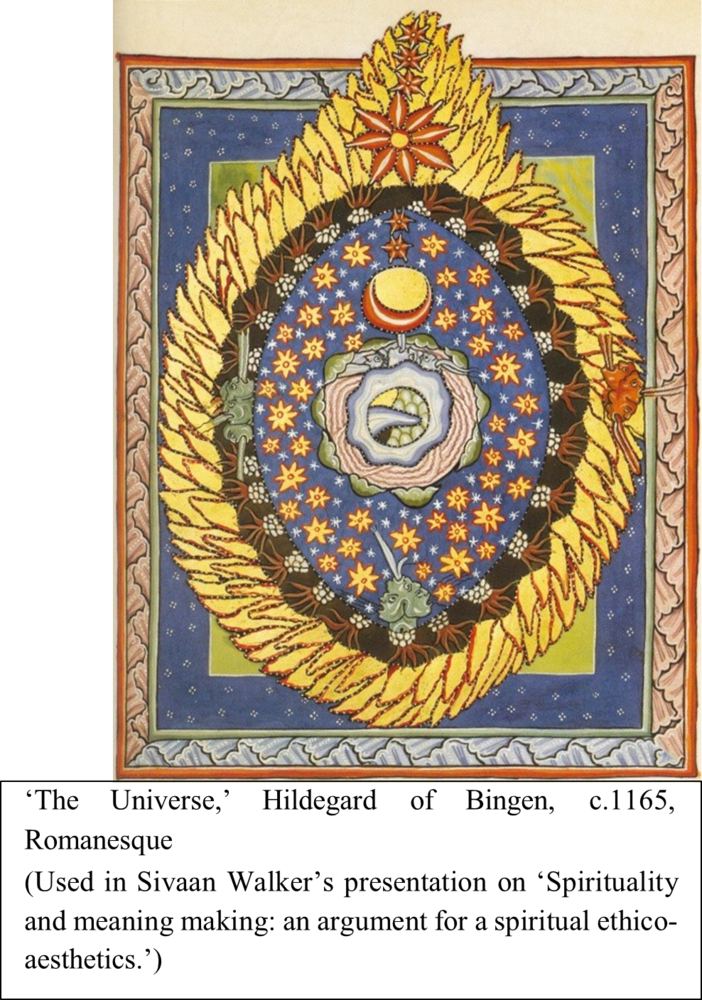
Sivaan Walker, a PhD candidate from the University of New South Wales, began the session with ‘Spirituality and meaning making: an argument for a spiritual ethico-aesthetics.’ Sivaan considered possibilities for ‘mystic and spiritual thinking’ in a world where people are increasingly non-religious. She drew upon the art of Hildegard von Bingen, specifically ‘The Universe,’ to demonstrate how women artists have long centred not only spirituality and spiritual thinking, but also connection between self, others and the divine, and to counter patriarchal injustices, while fostering peace and interconnection.
Misha Hoo, PhD candidate from the University of Tasmania, followed with ‘The Social Construction of Nature-Connectivity: How Australian Hikers Articulate Cultural Influences and Nonreligious Perspectives,’ in which she discussed her PhD research on the Three Capes Walk in Tasmania which is a curated hike that often acts as an initiation for people who have never hiked before. She drew on her interview and survey data to discuss the non-religious ways in which people who had undertaken this hike were engaging with nature and the more-than-human.
Dr Neville Buch, a historian and independent academic, provided philosophical insights into the concept of ‘secular’ in a presentation entitled ‘What happened to Secular Theology? European (including UK) and American Contributions to Non-Religion 1967-2025.’
Dr Rhys Gower, postdoctoral researcher at Western Sydney University, finished the day with ‘The 2021 Australian “Mark No Religion” Campaign,’ in which he discussed atheist activist organisations, specifically the “Mark No Religion” campaign in which a number of atheist organisations joined together to convince Australia to mark ‘no religion’ on the 2021 census if they were not actively involved or identifying with an institutional religion. He examined this through Ulrich Beck’s theory of risk.
Reflections
The Symposium was well received. This is apparent in the following set of short reflections written by attendees and organises. These reflections attest to the significance of an event focused on non-religion, secularism and spirituality, and they are a reminder that sociology of religion must continue to make space for the variety of ways in which people engage with non-religious and spiritual practices, ideas and communities. They also speak of the importance of gathering as a thematic group and community of scholars.
Misha Hoo, PhD Candidate
I really enjoyed this symposium and connecting with other scholars researching nonreligion, spirituality, and secularism. It was fascinating to see the diversity of approaches to this growing field and it was great to experience such a wide range of topics covered across the day. I especially appreciated the friendly and collegial style of this event which facilitated conversation between established scholars and postgraduate candidates. I hope we can do this again next year!
Mercedes Nachón Ramírez, PhD Candidate
I really appreciated the opportunity to share my research on neo-shamanism in Argentina and to explore how these questions connect with broader debates on spirituality in public life across different contexts. I particularly enjoyed the openness of the discussions and the welcoming environment for early career researchers, as well as the stimulating space created by the group of scholars present. I came away with valuable insights and a sense of potential future collaborations. I’m grateful to the organisers for creating such a thoughtful and supportive symposium.
Dr Neville Buch, historian and independent academic
The TASA-AASR Symposium on non-religion was the highlight of the year, from the low point of being suspended from a non-religion organisation. It also seemed to me that TASA-AASR is bold about its philosophy roots, compatibly holding together both sociological theories and lebensphilosophie in mutual understanding and respect.
Dr Rhys Gower, TASA Sociology of Religion Thematic Group Convenor
As a sociologist of non-religion, I was certainly pleased to see so many scholars and students now interested in the topics of non-religion, spirituality, and secularism. In my experience, social science research into non-religious phenomena has generally been regarded as a niche or novelty in Australia, particularly when compared to other, more established fields of inquiry (such as that of religion). But with over a third of the Australian population now identifying as non-religious, greater research into these fields is more relevant now than ever before. Even very foundational questions addressing what is means to be non-religious in Australia today deserve a greater deal of attention in scholarly work. In this regard, I feel the symposium did an outstanding job in not only showcasing the exciting work currently being undertaken in the field, but in also highlighting the inherent (and often overlooked) diversity of the non-religious space. It is my hope that these factors will inspire a new generation of scholars to consider researching the non-religious sphere.
Sivaan Walker, PhD candidate
As a first-time symposium presenter and PhD student, the Spirituality, Non-religion and Secularism in Public Society Symposium was a fantastic opportunity to meet individual researchers from across the country whose projects align with my own. I now have a broader scope of who is researching spirituality, religion and non-religion in Australia, and a potential network of researchers to keep in touch with.
Dr Katja Strehle
The symposium on Non-Religion, Spirituality and Secularism in Public was a success. It was inspiring to hear from colleagues of all levels who work in a similar field. The variety of activities, from panels, workshops to presentations enabled a high level of interactivity and engagement from several people. It was really eye opening seeing a community of people working within adjacent interests and attendees said they do not have this kind of community in their institutions. Many expressed their interest in attending another one of the same kind in the future. Also, there were several people who emailed me saying they were unable to join this year but would like to come if it happens again. So there seems to be a real need for and interest in an ongoing opportunity to engage and connect with people working in the field.
Conclusion
In deciding to host an event centred on non-religion, spirituality, and secularism, the sociology of religion thematic group conveners set out to create an event which not only connected relevant scholars but also generated interest and showcased the work currently being undertaken in these fields. In these respects, the symposium can be regarded as an overall success. The variety of presentations, panel discussions, as well as the workshop activity, allowed for a diversity of topics to be discussed and provided a meaningful and engaging environment for those in attendance. The value and importance of this event, the opportunity it provided to share work and to connect with others is evidenced in the reflections shared above.
In addition, collaboration with the AASR’s Women’s Caucus allowed for sharing of academic networks and a deeper collegial relationship between TASA and AASR. Finally, the different career stages and academic backgrounds of those who attended, including undergraduate students, postgraduate students, early career researchers, and senior academics from Australia and abroad, speak to the levels of interest in the fields of non-religion, spirituality, and secularism, as well as the potential for further collaborations and engagement.
References
Australian Bureau of Statistics 2022, Religious affiliation in Australia: Exploration of the changes in reported religion in the 2021 Census, 4 July, viewed 13 September 2024,
<https://www.abs.gov.au/articles/religious-affiliation-australia>
Gower, R 2021, Exploring Trajectories of Active Atheist Identity Formation in Australia, Unpublished PhD thesis. Sydney: Western Sydney University.
Halafoff, A & Gobey, L 2018, ‘”Whatever”? Religion, Youth, and Identity in 21st Century Australia’. In Gareau, PL,
Bullivant, SC, & Beyer, P (eds.), Youth, Religion, and Identity in a Globalizing Context. Leiden: Brill, pp.255-277.
Halafoff, A, Shipley, H, Young, PD, Singleton, A, Rasmussen, ML, & Bouma, G 2020 ‘Complex, Critical and Caring: Young People’s Diverse Religious, Spiritual and Non-Religious Worldviews in Australia and Canada’, Religions, vol.11, no.4, p.166.
Halafoff, A, Singleton, A & Poulos, E 2024, ‘Querying “No Religion”: State, Society, and Spirituality in Australia’, Australian Journal of Law and Religion, vol.5, pp.83-88.
Hughes, P 2017, ‘‘No Religion’ in the Australian Census’. Pointers: Bulletin of the Christian Research Association, vol.27, no.3, pp.5–10.
Nixon, A 2014, New Atheism as a Case of Competitive Post Secular Worldviews, Unpublished PhD thesis, Sydney: University of Western Sydney.
Pew Research Center 2015, The Future of the World Religions. Population Growth Projections, 2010-2050. Washington: Pew Research Center.
Possamai, A, Kamp, A & Gower, R 2024, ‘Overseas Born “Religious Nones” in Australia’,
Secularism and Non-Religion, vol.13, no.5, pp.1-12.
Possamai a & Tittensor, D 2022, Religion and Change in Australia, Routledge, Abingdon [UK].
Singleton, A 2015, ‘Are Religious ‘Nones’ Secular? The case of the Nones in Australia’, Journal of Beliefs & Values, vol.36, no.2, pp.239-243.