Welcome to the last issue of JoS for 2025! For this anniversary issue, celebrating 60 years of the journal, we have put together a special, curated anniversary section which we introduce in detail in our editorial here. Following this, you will also find four conventional, original research articles that all focus on Indigenous lives. We hope you will enjoy this issue over the summer.
The journal will be taking a summer break and return to business in late January, so if you submit papers during this time, please note they will not be handled until then.
We hope you all have a happy and restful holiday break!
Signe Ravn and Ashley Barnwell
Editors-in-Chief
| Special Anniversary Issue: 60 years of Journal of Sociology | | Symposium on Alan Davies’ ‘The Child’s Discovery of Social Class’ |  | Listening Differently: Centring Children and Young People’s Voices in Understanding Sexual Violence
By Janelle Rabe
Read the full article here |
 | Through the Child’s Eye: Navigating Family Relationships in the Context of Violence
By Sofie Henze-Pedersen
Read the full article here |
|
 | The “Child’s Eye” View and its Social Resonance: A. F. Davies and Sociology
By John Cash
Read the full article here |
|
An Interview with Fran Collyer
Fran Collyer and Ashley Barnwell
Professor Fran Collyer is a revered sociologist currently leading a mammoth ARC-funded project about the history of sociology in Australia. The project includes interviews with almost 200 Australian sociologists. For this special section celebrating JoS’ 60th Anniversary, JoS co-Editor-in-Chief, Ashley Barnwell, turned the microphone on Fran to learn more about the history of our discipline. Prior to her current position at the University of Wollongong, Fran Collyer was Professor of Sociology in Sweden and the University of Sydney. Fran is the author of important titles such as the Research Handbook on the Sociology of Knowledge (2025); Knowledge and Global Power (2019, with Raewyn Connell, Joao Maia and Robert Morrell); Navigating Private and Public Healthcare (2020, with Karen Willis); The Palgrave Handbook of Social Theory in Health, Illness and Medicine (2023, Chinese edition; 2015 English edition); and Mapping the Sociology of Health and Medicine (2012). She has been a leader in both The Australian Sociological Association and the International Sociological Association, and currently President of the ISA History of Sociology Research Committee. Fran is Managing Editor of Serendipities: Journal for the Sociology and History of the Social Sciences, and is former Editor-in-Chief of Health Sociology Review. In addition to wishing JoS a Happy Birthday, the interview showcases Fran’s ground-breaking research in honour of her 2024 Distinguished Service to the Australian Sociological Association Award, recognition of her career-long contribution to the sociology community. The conversation unfolded via zoom on a summer’s day, Fran in New South Wales, and Ashley in Victoria, with Trixie the dog, and Kitti Bisquitti the cat, respectively, making cameo appearances.
Read the full article here | | Up from the archive: A new generation revisits the past | | Up from the archive: Disability, Queerness, and the Politics of Worth. Kim Andreassen thinks with Beswick 1970
By Kim Andreassen
Read the full article here |
| Up from the archive: A Half Century of the Neoliberal Individual. Tom Short thinks with Foster & Williams 1980
By Tom Short
Read the full article here |
|
| Up from the archive: Motherhood and Feminism Revisited. Brooklyn Donnelly thinks with Davies and Welch 1986
By Brooklyn Donnelly
Read the full article here |
|
|
Up from the archive: Online Self-Help and Relationship Advice. Justine Topham thinks with Hazleden 2003
By Justine Topham
Read the full article here |
|
Up from the archive: Conceptualising the Ambivalence and Complexity of Migrant Belonging. Natalie Calleja thinks with Noble 2013
By Natalie Calleja
Read the full article here |
|
|
Up from the archive: On stigma, resilience and chosen families. Hassan Khalil thinks with Bernard Gardiner 2018
By Hassan Khalil
Read the full article here |
|
 | | “Ginhar Gambidyawa-galang Guray-gu-galang” (Strong Womens’ Voices) by artist Dylan Barnes. For a description of the artwork, please see the Make Us Count report.
Performing Equity, Preserving Power: The Double Bind for Aboriginal Australian Women in Public Sector Workplaces
Debbie Bargallie and Bronwyn Carlson
In Australian public institutions, Aboriginal women’s visibility is often mobilised as an instrument of containment rather than a marker of structural change. Focusing on the Victorian Public Sector, this article examines how equity regimes incorporate Indigenous presence while preserving settler-colonial authority. Drawing on Make Us Count and interviews with 25 Aboriginal women, we show how they are hypervisible as symbols of diversity and reconciliation, yet excluded from leadership, safety and decision-making. This double bind is produced through the intersecting operations of race, gender, settler sovereignty and bureaucratic whiteness, in which Aboriginal women perform cultural and emotional labour under conditions of conditional belonging, while their critique is marginalised or penalised. Using Ali Meghji’s notion of theoretical synergy, we bring Critical Race Theory and Critical Indigenous Studies into the conversation, drawing particularly on Aileen Moreton-Robinson’s theorisation of the white possessive logic. We argue that equity, as currently enacted, operates as symbolic inclusion, a technology of governance that sustains institutional power, contributing to critical debates on race, settler colonialism, whiteness and Indigenous refusal.
Read the full article here |  | | Photo by Gilles Lambert on Unsplash
Threads of connection and contention: Social media linking Australian Indigenous and Jewish communities
Zac Roberts
The global rise of social media over the past decade has meant that individuals are increasingly forming connections with others outside of their immediate social, geographical, or cultural contexts. Although there has been growing scholarly interest in how different cultural and religious communities operate on social media, very little is known about how these groups use these online spaces to engage with other communities. This article explores how social media is used as a mechanism for connection and contention between Australian Indigenous and Jewish communities. I argue that while these online spaces offer a unique opportunity for fostering meaningful connections between the two communities, these interactions are also shaped by inherent barriers that influence how these communities engage with each other online. As such, this article contributes to the growing body of scholarship exploring relationalities between minority communities in Australia.
Read the full article here | 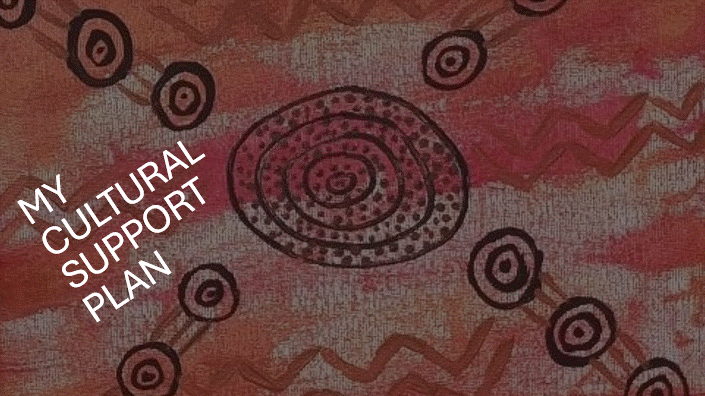 | | Artwork by Carol Michie
‘People don’t trust those pieces of paper that are provided’: A qualitative study of cultural planning and outsourced out-of-home care services in Western Australia
Sharynne Hamilton, Larissa Jones, Millie Penny, Charmaine Pell, Sarah Maslen, Carol Michie, Raewyn Mutch, Melissa O’Donnell, Carrington Shepherd and Brad Farrant
Aboriginal and Torres Strait Islander children continue to be removed at high rates from their families by child protection services, placing them at elevated risk of adverse long-term life outcomes. Cultural connection in out-of-home care is essential for mitigating the impacts of trauma from removal, emphasizing the importance of ensuring that cultural planning is rigorously undertaken. This article explores the provision of cultural plans in an era where out-of-home care services are outsourced by government, but where government holds onto the responsibility for developing cultural plans for children in care. We examine the views of out-of-home care agency workers and non-Indigenous foster carers about receiving cultural information for children in their care. The findings suggest that government has failed to provide leadership and guidance or be responsive, and reveal a shift in the missions of non-governmental organizations and their commitment to providing culturally secure services to Aboriginal and Torres Strait Islander children.
Read the full article here | 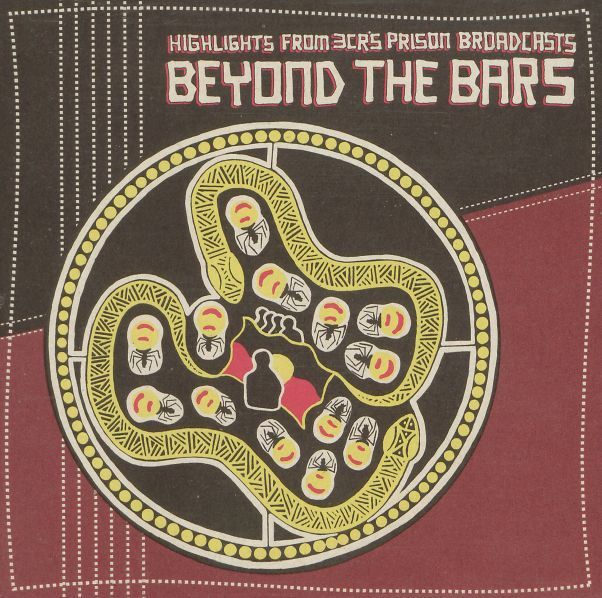 | | CD booklet cover art from Beyond the Bars: Highlights from 3CR's Prison Broadcasts NAIDOC Week 2004. Artist unknown.
‘Beyond the Bars Community Radio Programme, a Decolonial Practice?
Liz Dean, Claire Loughnan and Juliet Fox
An ethics of engagement community project was co-developed with 3CR Community Radio to learn about their Beyond the Bars radio programme, a radio broadcast produced in ‘prisons’. A collaboration with a First Nations broadcaster, a 3CR settler producer and two settler academics created a knowledge sharing project with local community radio, to demonstrate how Beyond the Bars can be considered a decolonial practice. This paper reflects on this programme to argue that it creates space- for Indigenous broadcasters and First Nation's people incarcerated to be heard, and to connect with family, community and Country. Broadcast participation means First Nations peoples speak for themselves and reconfigure negative media portrayals, the paper shows. We learn from this community engagement that Beyond the Bars broadcasts contribute to citizen participation despite this problematic ‘carceral setting’. We conclude by briefly suggesting that the collaborative project shows how radio content making participates in a decolonial practice.
Read the full article here |  | |